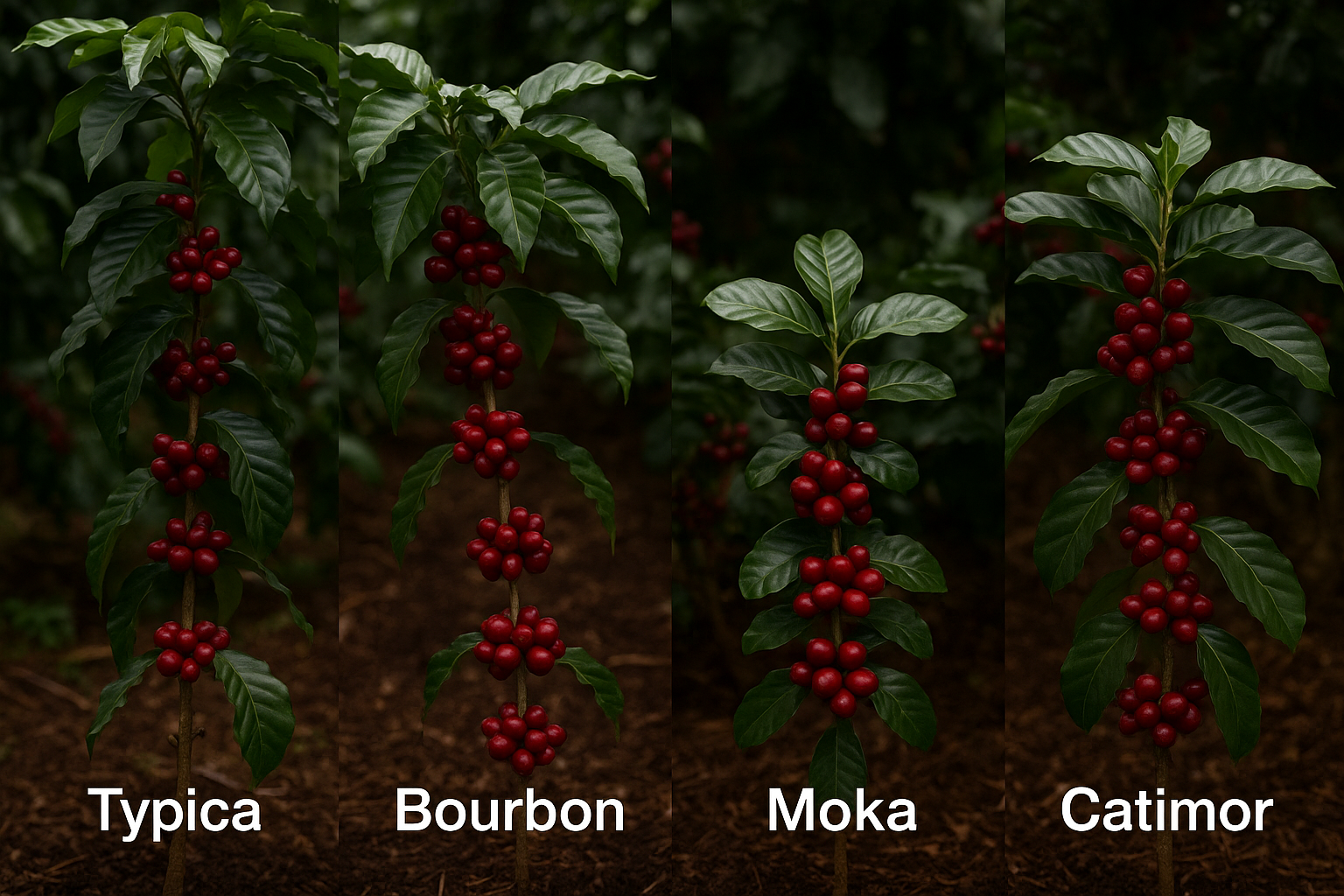
In-depth exploration of the popular Arabica coffee varieties in Vietnam, such as Typica, Bourbon, Moka, Catimor, and other promising new cultivars. A comprehensive analysis from the perspectives of botany, sensory characteristics, and commercial potential.
Introduction: Why Arabica Is a Strategic Pillar
As the global coffee industry shifts toward sensory value and traceability, Arabica is becoming a strategic direction for Vietnam to elevate its high-quality coffee image. Unlike Robusta, which dominates in volume, Arabica offers greater value through its refined flavor profile, balanced acidity, and alignment with international consumer preferences.
Arabica currently accounts for only 8–10% of Vietnam’s total coffee cultivation area, mainly grown in highland regions such as Cầu Đất – Đà Lạt, Sơn La, and Khe Sanh – Quảng Trị. However, these regions are also where key Arabica cultivars are gaining momentum in the specialty and premium coffee markets.
Typica – The Original Genetic Foundation of Arabica
Typica is one of the oldest Arabica varieties, considered the genetic ancestor of most commercial Arabicas today. Originating in Ethiopia, Typica spread through Yemen, Indonesia, and arrived in Vietnam during the 19th century under French colonial influence.
It features tall trees, sparse foliage, and long, slender beans. While it thrives at elevations above 1,300 meters, it is highly susceptible to leaf rust and has low yields. However, Typica is highly valued for its delicate, clean flavor, bright acidity, sweet aftertaste, and elegant floral-fruity notes.
In Vietnam, Typica is being revived in old-growth gardens in Cầu Đất as part of a heritage varietal restoration strategy for the specialty segment.
Bourbon – Natural Sweetness and Balanced Flavor
Bourbon is a natural mutation of Typica, first discovered on Bourbon Island (now Réunion, France). Introduced to Vietnam by the French in the late 19th century, it was once widely grown in northern and central highlands.
Bourbon trees are shorter than Typica, produce rounder cherries, and yield 20–30% more. When processed correctly, Bourbon beans offer superior quality with rounded sweetness, mild acidity, and complex aromas of caramel, vanilla, ripe fruit, and flowers.
Both Red and Yellow Bourbon are now favored by specialty roasters and are being cultivated in Lâm Đồng, Sơn La, and Đắk Nông.
Moka (Mocha) – A Rare Classical Heritage
Known in Vietnam as Moka, the Mocha variety originated in Yemen. One of the most classical Arabica lines, it is renowned for its seductive aroma and distinctive brown acidity.
Moka plants are short and sensitive to climate and disease. Yields are extremely low, but the quality is outstanding. The small, round beans have thin skins and when roasted, emit aromas of chocolate, damp earth, hazelnut, and a classic aftertaste.
In Vietnam, Moka is nearly exclusive to Cầu Đất, grown in old gardens with special care and selective hand-picking. It is highly valued in limited-edition product lines.
Catimor – A Practical, Farmer-Friendly Choice
Catimor is a hybrid between Timor Hybrid (with disease-resistant Robusta genes) and Caturra (a dwarf Bourbon variant), developed in Portugal to withstand harsh growing conditions while delivering high yields.
Catimor has good resistance to leaf rust, low-growing stature, uniform ripening, and mechanical harvest compatibility, making it suitable for mid-altitude regions. However, in terms of cup profile, it is often deemed less remarkable: bold body, low acidity, short finish.
Today, Catimor makes up the majority of Arabica acreage in Vietnam, especially in Sơn La and Quảng Trị, serving as a stable supply for exporters and domestic markets.
Promising New Arabica Varieties
To improve Arabica quality amid climate change and the rise of specialty coffee, several new cultivars are under trial and expansion in Vietnam:
- SL28 and SL34 (Kenya): known for high acidity, complex tea-like and red fruit notes, ideal for natural and honey processing.
- Pacamara: a cross between Maragogype (large bean) and Pacas (Bourbon), offering bold flavor, light spice, and large bean size.
- Castillo, Colombia: good disease resistance, stable yield, potential for development in midland and highland areas.
These varieties are being trialed in Lâm Hà, Cầu Đất, Măng Đen, and parts of the Northwest region.
Key Arabica Growing Regions in Vietnam
Cầu Đất – Đà Lạt (Lâm Đồng): 1,450–1,650m altitude, cool climate year-round. Home to Typica, Bourbon, and Moka, producing top specialty quality.
Sơn La – Northwest: 1,000–1,200m altitude, cold winters. Catimor here shows improved cup when processed as honey or natural.
Khe Sanh – Quảng Trị: largest Arabica region in Central Vietnam, 600–1,100m altitude. Strong logistics and integrated supply chains.
Ngọc Hồi – Kon Tum, Đắk G’Long – Đắk Nông: young basaltic soils, newly planted with Bourbon and promising lines.
Conclusion: Arabica as a Strategic Path for Vietnamese Coffee
Arabica coffee represents a key opportunity for Vietnam to claim its place in the global specialty coffee value chain. Each variety carries a unique identity, not just in flavor, but also in culture, terroir, and cultivation expertise.
Preserving heritage varieties like Typica and Bourbon, reviving Moka gardens, and scaling up climate-resilient, quality-focused cultivars are crucial steps for Vietnam to become a major specialty coffee producer in the next decade.
